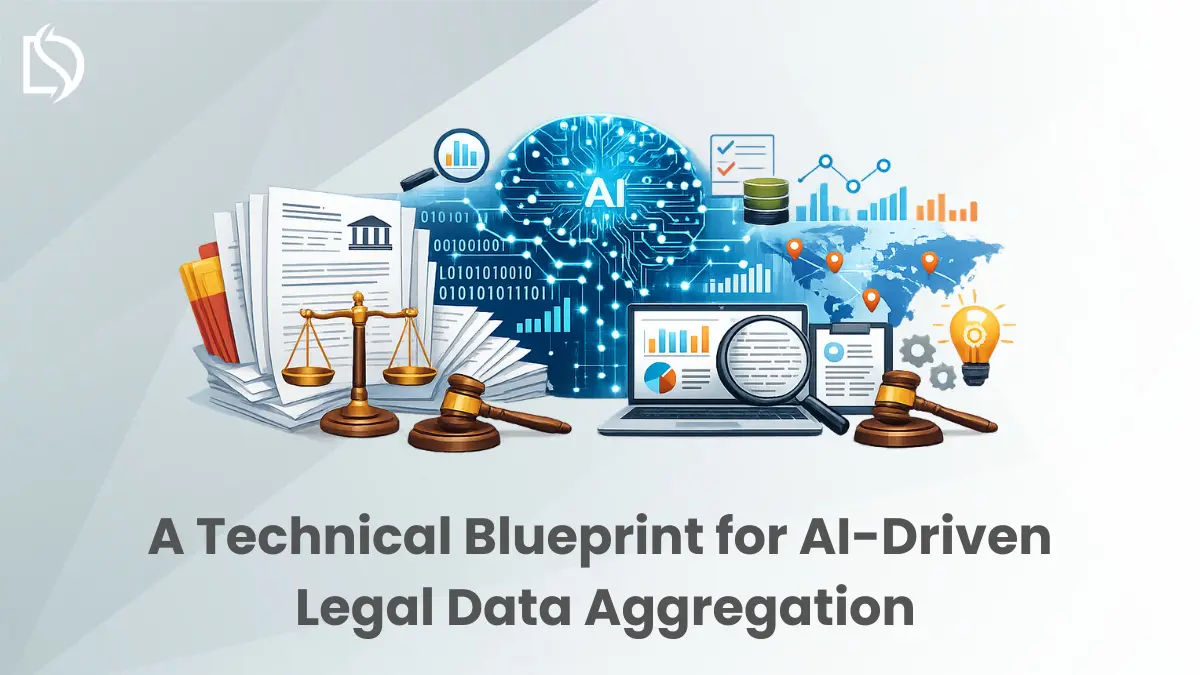
From Raw Court Filings to Actionable Intelligence: A Technical Blueprint for AI-Driven Legal Data Aggregation
By: The Data Engineering Team at DataSOS Technologies
In the legal technology and compliance sectors, acquiring public court records represents only the initial phase of the data lifecycle. Once data engineers successfully navigate municipal portals and digitize legal documents, they are presented with a secondary, often more complex technical challenge: backend aggregation.
Converting millions of isolated, digitized civil complaints into a cohesive, queryable intelligence platform requires specialized backend architecture. Processing high-volume legal data necessitates systems capable of resolving fragmented corporate entities, mapping hidden relationships, and serving insights to downstream applications with sub-second latency.
At DataSOS Technologies, our infrastructure processes over 15 billion data points monthly. Moving beyond the extraction phase, this article outlines a technical blueprint for designing a modern, scalable, AI-driven legal data aggregation pipeline, tailored for enterprise risk platforms and compliance engines.
1. Decoupled Ingestion via Event-Driven Architecture
Legal data intake operates on highly variable schedules. Different municipal jurisdictions publish updates at random intervals, resulting in bursty, asymmetrical data streams. Using traditional synchronous batch processing, like nightly cron jobs, for this type of ingestion often leads to server bottlenecks and unacceptable data latency. A resilient legal aggregation blueprint employs an Event-Driven Architecture (EDA).
- Asynchronous Message Brokers: The raw payloads aren’t written to a primary database as scraping nodes acquire additional court dockets/PDFs. Instead, they are published as events to a high-throughput message broker like Apache Kafka or RabbitMQ. For teams managing large-scale ingestion across fragmented sources, see our guide on designing a modern data stack for enterprise agility
- System Decoupling: The ingestion layer is architecturally decoupled from the transformation layer by publishing to a distributed log. And when a state court system suddenly receives 50,000 filings, the intake systems are stable. The messages are queued securely so downstream microservices can consume and process the documents at their optimal computational capacity – typically written in Node.js or Python.
- Fault Tolerance: This architecture ensures full data retention. When one processing node fails mid-transformation, that event is kept in the queue for reprocessing so no legal filing is dropped from the pipeline.
2. Advanced Entity Resolution Utilizing Graph Databases
Following the extraction of text from legal filings, systems must address Entity Resolution.
A single corporate defendant may be listed across various county courts under numerous name variations (e.g., “DataSOS Tech,” “Data SOS Technologies LLC,” “DataSOS”). Furthermore, complex corporate structures and subsidiaries can obscure primary ownership. Storing this relational data in a traditional SQL database requires computationally expensive JOIN operations that degrade application performance at scale.
To transform fragmented entity names into actionable intelligence, modern aggregation pipelines deploy Graph Databases (such as Neo4j or Amazon Neptune).
- Node and Edge Architecture: In a graph database, data points are stored as nodes (Entities: Individuals, Corporations, Addresses) and edges (Relationships: “IS_SUING,” “SUBSIDIARY_OF,” “REGISTERED_AT”).
- Mapping Corporate Structures: When a new lawsuit is ingested, the pipeline utilizes AI-driven fuzzy matching algorithms to determine if a newly extracted entity matches an existing node. Upon a successful match, a new relationship edge is established.
- Query Efficiency: This architecture allows compliance officers or risk analysts to execute highly efficient queries to reveal a company’s complete litigation profile. Users can instantly visualize all legal actions associated with a parent company, its subsidiaries, and registered executives across multiple jurisdictions without noticeable latency.
3. Implementing Vector Embeddings for Semantic Search
While structured metadata (Plaintiff Name, Filing Date, Case Type) is necessary for filtering, significant intelligence often resides within the unstructured narrative of the legal complaint.
Historically, querying this text relied on basic keyword indexing methodologies (such as Elasticsearch). If an analyst searched for “environmental negligence,” the system would only return documents containing those exact strings, potentially omitting relevant lawsuits that utilized phrases like “ecological damage” or “toxic spill.”
The modern aggregation blueprint resolves this limitation through Vector Embeddings and Retrieval-Augmented Generation (RAG).
- Generating Embeddings: As unstructured legal complaints pass through the ETL (Extract, Transform, Load) pipelines, the text is processed by Large Language Models (LLMs). The model converts the legal narrative into high-dimensional mathematical vectors based on semantic meaning.
- Vector Storage: These embeddings are indexed and stored in specialized vector databases.
- Contextual Querying: When a downstream user queries the system, the platform calculates the mathematical proximity of the user’s query vector to the document vectors. This returns filings that match the contextual meaning of the search, regardless of the specific terminology utilized by the filing attorney.
4. Cryptographic Provenance and Data Lineage
In enterprise risk management and legal compliance, data validity is paramount. If an algorithmic trading model or a compliance dashboard flags a vendor based on a newly aggregated bankruptcy filing, auditors require absolute certainty regarding the origin of that signal.
A robust data aggregation architecture must include an immutable audit trail, referred to as Data Lineage.
- Pointer Architecture: Our data pipelines retain the raw source material. When a structured JSON object is generated, it includes cryptographic hash pointers linking directly to the raw, unedited TIFF or PDF stored securely in a scalable data lake (e.g., AWS S3 or Azure Blob Storage).
- Comprehensive Metadata Tracking: Every extracted entity is tagged with operational metadata, detailing the specific microservice that processed it, the AI model version utilized for extraction, the exact timestamp of the scrape, and the source URL.
- Audit Verification: This framework enables legal and compliance teams to verify structured data points instantly. By tracing the lineage pointer, users can retrieve the original county court document and identify the exact paragraph from which the data point was derived.
Architecting Enterprise Data Ecosystems
Developing a comprehensive legal data aggregation backend requires specialized engineering expertise spanning cloud infrastructure, machine learning deployment, and high-performance computing.
At DataSOS Technologies, we serve as the dedicated data engineering partner for forward-thinking enterprises. We architect custom software ecosystems tailored to exact operational and analytical requirements. Our technology stack is built on robust foundations, utilizing .NET, Python, AWS, Kubernetes, and specialized NoSQL environments to manage the entire data lifecycle.
We operate with a compliance-first approach, ensuring that the ingestion, transformation, and storage of highly sensitive data meet rigorous benchmarks for quality management and information security.
To optimize your data architecture for high-volume aggregation, schedule a technical review with the DataSOS Technologies engineering team to explore custom infrastructure solutions.
SUBSCRIBE TO OUR NEWSLETTER
RECENT POSTS
 How to Create LLM-Ready Datasets from Public Web Data
- Data Scraping for AI Training: Legal and Ethical Considerations in 2026
- Building Self-Healing Data Extraction Pipelines With AI
- How AI Data Collection is Changing Legal Research in 2026
- How AI Agents Are Replacing Traditional Web Scraping Workflows