How to Create LLM-Ready Datasets from Public Web Data
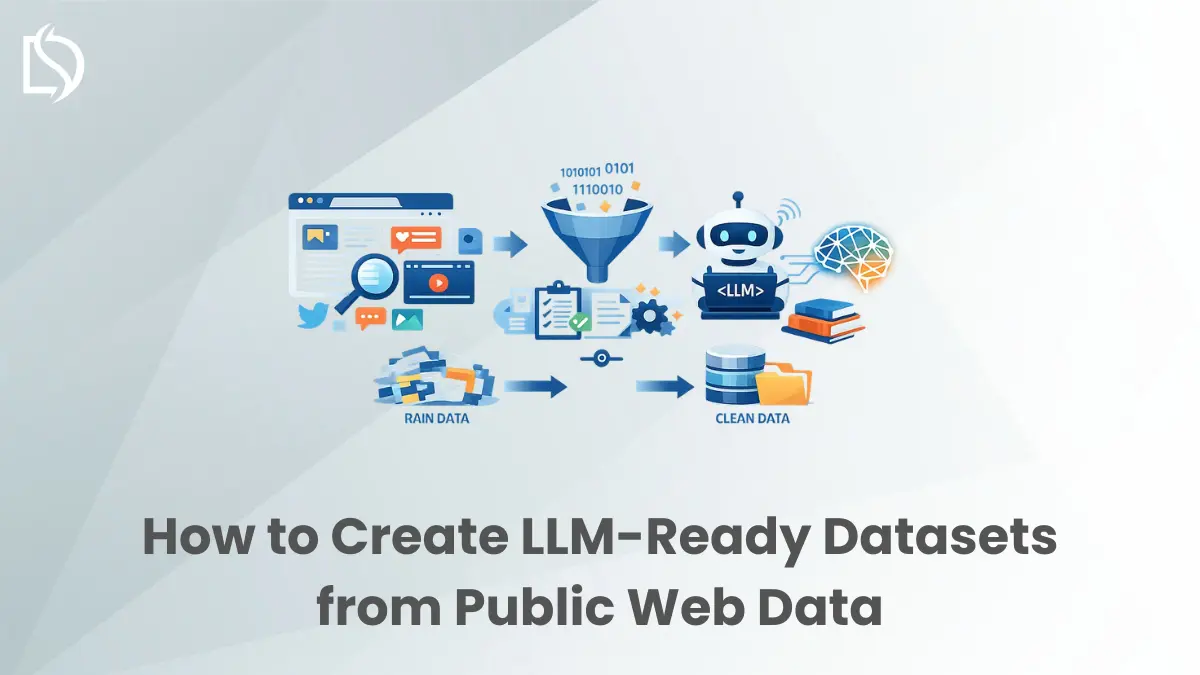
An LLM-ready dataset is public web data that has been cleaned of boilerplate, deduplicated at both the document and chunk level, split using a chunking strategy matched to your retrieval pattern, tagged with source and provenance metadata, and delivered in a format your embedding or fine-tuning pipeline can ingest directly.
What “LLM-Ready” Actually Means
Most teams treat scraping as the finish line. You pull the HTML, strip the tags, save it as text, and call it a dataset. Then retrieval quality is inconsistent, fine-tuning runs cost more than expected, and nobody can explain why the model keeps citing the same three pages. The problem usually isn’t the model. It’s that “scraped” and “LLM-ready” are two different states, and most of the work happens in the gap between them.
A genuinely LLM-ready dataset has gone through five things a raw scrape hasn’t: cleaning, deduplication, chunking matched to how the data will actually be used, metadata that makes every record traceable back to its source, and a delivery format your pipeline can ingest without another conversion step. Skip any one of these and the dataset will still load. It just won’t perform.
Step 1: Acquire Data Without Poisoning It Later
Acquisition quality determines everything downstream. A scraper that silently returns incomplete records, ignores rate limits, or grabs content behind access controls doesn’t just create a legal exposure question, it seeds bad data into a dataset that’s expensive to clean up after the fact. Building this correctly from the start, with resilient, compliance-aware acquisition pipelines, is cheaper than retrofitting a dataset that was scraped fast and messy.
Step 2: Clean and Normalize Before the Model Ever Sees It
Raw HTML is mostly noise from a model’s perspective: navigation menus, cookie banners, ad slots, related-article widgets, and comment sections. Converting to Markdown instead of stripping to plain text preserves structure that actually helps a model, like headings, lists, and tables, while dropping the visual cruft. Encoding normalization, language detection, and boilerplate removal all belong here too. Do this well and later steps get cheaper. Skip it and you’re deduplicating and chunking noise alongside the signal.
Step 3: Deduplicate, Because This Step Quietly Decides Model Quality
Public web data is repetitive in ways that aren’t obvious until you measure it: syndicated articles, mirrored product pages, boilerplate legal text repeated across thousands of domains. Left in, near-duplicates skew training toward whatever got repeated most, not what matters most, and in RAG they clutter retrieval results with redundant chunks that push out genuinely different information.
Exact-match deduplication after text normalization catches the obvious cases. Near-duplicate detection, typically MinHash with locality-sensitive hashing, catches reworded or partially overlapping content that exact matching misses. Some teams go further with embedding-based semantic deduplication, clustering similar content and keeping only the highest-quality representative. The tradeoff is real: too aggressive, and you lose legitimate variation; too light, and redundancy quietly inflates both cost and noise.
Step 4: Chunk Based on Benchmarks, Not Best-Practice Folklore
This is where most advice on the internet is stale. The common recommendation is semantic chunking: split text where meaning shifts, not at arbitrary token counts. It sounds right. A widely cited 2026 chunking benchmark found the opposite in practice: semantic chunking scored notably lower on real document retrieval accuracy than plain recursive splitting at a fixed 512 tokens with 10 to 20% overlap. The reason is that semantic chunking tends to produce very short fragments that retrieve cleanly but don’t hand the model enough surrounding context to generate a correct answer. Clean retrieval isn’t the goal; a correct answer is.
The practical takeaway isn’t that semantic chunking is always wrong. It’s that fixed-size recursive splitting is the benchmark-backed default for general-purpose RAG, and semantic chunking should be a deliberate choice for specific document types (long-form legal or technical text, for instance) rather than the automatic default most tutorials treat it as. Whichever approach you pick, overlap between chunks needs deduplication on the retrieval side too, or you end up paying to embed and store the same sentence three times.
Step 5: Attach Metadata and Provenance, Not Just Text
A chunk of clean text with no source URL, scrape timestamp, or licensing status is a liability waiting to surface later, not a finished asset. This matters for retrieval quality (metadata enables filtering and hybrid search) and increasingly for compliance: EU AI Act data governance rules already require documented provenance for training data behind high-risk systems, and that bar is only getting more common globally. The same due-diligence questions we’ve written about for evaluating a web scraping provider, auditability, ToS adherence, and privacy law compliance, apply directly to whoever is building your training or RAG dataset.
Step 6: Pick the Right Output Format
- JSONL: the standard for fine-tuning pipelines and most modern training frameworks, one record per line, easy to stream and validate.
- Parquet: columnar storage that pays off at large scale, faster to query and filter than JSONL when a dataset runs into the tens of millions of rows.
- Markdown with structured front matter: the natural format for RAG ingestion, since it preserves document structure while keeping metadata attached to each file.
Whichever format you choose, keep chunk-level metadata (source, timestamp, chunk index, token count) embedded in the record itself rather than in a separate lookup table. Separate tables drift out of sync; embedded metadata doesn’t.
Where Teams Get This Wrong
- Treating the scrape as the deliverable, then discovering retrieval or fine-tuning quality problems weeks later when the actual cause was upstream.
- Defaulting to semantic chunking because it’s the most-cited recommendation, without testing it against a fixed-size baseline on their own documents.
- Deduplicating documents but not chunks, so overlapping windows from the same source still flood retrieval results.
- Skipping provenance metadata because it doesn’t affect this quarter’s demo, then rebuilding it under pressure when a compliance review asks where the data came from.
How DataSOS Builds LLM-Ready Pipelines From Web Data
This is the same discipline we bring to every data pipeline and automation engagement: acquisition built for reliability and compliance from day one, cleaning and structuring that doesn’t get treated as an afterthought, and delivery in whatever format your model or vector store actually needs. You can see the same standards applied to production systems across industries in our case studies, or talk to our team about turning public web data into a dataset that’s actually ready for your model, not just scraped and hoped for.
Frequently Asked Questions
What makes a dataset "LLM-ready" as opposed to just scraped?
A scraped dataset is raw text pulled from the web. An LLM-ready dataset has been cleaned of boilerplate, deduplicated at both the document and chunk level, split using a chunking strategy matched to how it will be used, tagged with source and provenance metadata, and delivered in a format your pipeline can ingest directly, such as JSONL or Parquet.
Is semantic chunking better than fixed-size chunking for RAG?
Not by default. A widely cited 2026 benchmark found fixed-size recursive splitting at 512 tokens with 10 to 20% overlap outperformed semantic chunking on real document retrieval accuracy, because semantic chunking tends to produce fragments too short to give the model enough context. Fixed-size splitting is the safer general-purpose default; semantic chunking works best as a deliberate choice for specific document types rather than an automatic one.
How much deduplication is too much?
Deduplication that’s too aggressive strips out legitimate variation and can narrow a dataset’s diversity. Too light, and near-duplicates skew training toward overrepresented content and clutter retrieval with redundant chunks. Exact-match deduplication after normalization is safe to apply broadly; near-duplicate methods like MinHash-LSH and embedding-based semantic deduplication need a similarity threshold tuned against your own data rather than applied blindly.
Why does provenance metadata matter for a training dataset?
Beyond improving retrieval through filtering and hybrid search, provenance is increasingly a compliance requirement. The EU AI Act’s data governance rules for high-risk systems require documented training data provenance, and that expectation is spreading well beyond the EU. Building an audit trail (source URL, timestamp, licensing status) into the dataset from the start is far cheaper than reconstructing it later.
What format should an LLM-ready dataset be delivered in?
It depends on the use case. JSONL is the standard for fine-tuning pipelines. Parquet scales better for very large datasets that need fast querying and filtering. Markdown with structured front matter works well for RAG ingestion since it preserves document structure alongside metadata. In all cases, keep chunk-level metadata embedded in the record itself rather than in a separate lookup table that can drift out of sync.
SUBSCRIBE TO OUR NEWSLETTER
RECENT POSTS
 How to Create LLM-Ready Datasets from Public Web Data
- Data Scraping for AI Training: Legal and Ethical Considerations in 2026
- Building Self-Healing Data Extraction Pipelines With AI
- How AI Data Collection is Changing Legal Research in 2026
- How AI Agents Are Replacing Traditional Web Scraping Workflows