What Is RPA? A Strategic Guide for Business Leaders
By: The Data Engineering Team at DataSOS Technologies
Look closely at your daily operations. How many of your highly skilled employees spend their mornings downloading a CSV from one portal, formatting it in Excel, and manually uploading it into your legacy ERP system?
In the enterprise world, we call this “Human Middleware.” When you force your workforce to act as human bridges between disconnected digital systems, you establish a hard ceiling on your company’s scalability. Humans have volume caps. They make typographical errors when fatigued. And most importantly, paying human talent to perform robotic tasks is a massive drain on your operational budget and employee morale.
The solution is not a multi-year, multi-million-dollar IT overhaul. The solution is Robotic Process Automation (RPA).
At DataSOS Technologies, we engineer high-performance digital workforces for global enterprises. We help business leaders replace manual bottlenecks with intelligent, 24/7 automated execution. If you are an Operations Manager, CTO, or business leader looking to scale efficiently, here is your definitive guide to understanding RPA.
What Exactly is RPA?
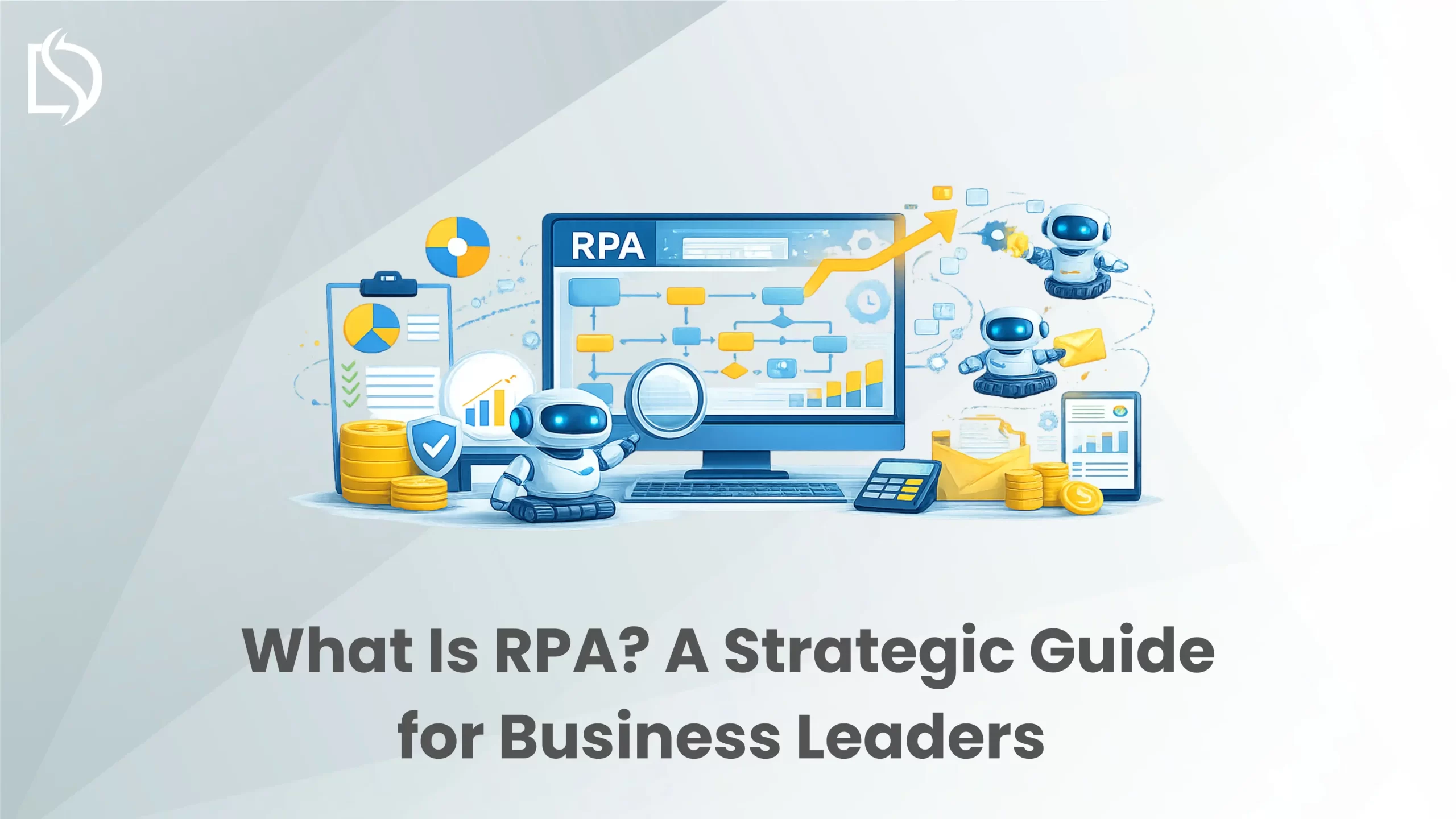
Robotic Process Automation or RPA is the engineering of “software robots” or “bots” that imitate human interaction with digital systems.
Unlike traditional software integrations, which require complex backend API development, we do not require such backend API development. RPA operates at the User Interface level. Bots login into applications, navigate screens, click buttons, read text and extract data just like a human employee would – only faster and without errors.
If a human following a strict rule-based process can complete a task on a computer, an RPA bot can be programmed to do it autonomously.
Overcoming Legacy Gridlock
The most important strategic advantage is that RPA will not be invasive.
Many established enterprises still use mission-critical legacy systems without modern APIs, such as older mainframes, AS400 or SAP instances. Upgrading/replacing these systems is very costly/risky. RPA uses the UI for interaction and does not require backend APIs.
Now you can automate data entry into a 20 + year old closed system and extend the life of your legacy architecture while achieving modern operational velocity.
The “Hands” vs. The “Brains”: RPA vs. AI
A common misconception among business leaders is conflating RPA with Artificial Intelligence (AI). While they are highly synergistic, they serve entirely different functions:
- RPA is the “Hands”: Standard RPA is deterministic and rule-based. It follows strict instructions. It cannot “think” or make judgment calls outside of its programmed parameters.
- AI is the “Brains”: AI is cognitive. It can read unstructured data, interpret sentiment, and adapt to changes.
Intelligent Automation occurs when you combine the two. For example, An AI model (the brain) uses Optical Character Recognition (OCR) to read a messy, handwritten invoice and extract the total amount. The RPA bot (the hands) then takes that extracted amount and securely logs it into your accounting software.
The Digital Workforce: Types of RPA Bots
When engineering a digital workforce, we deploy different types of bots depending on the workflow requirements.
1. Unattended Automation (Server-Side Bots)
These are the heavy lifters of the back office. Unattended bots run autonomously on secure virtual servers, 24/7/365, requiring zero human interaction.
- How they trigger: They are activated by schedules (e.g., a batch process running at 2:00 AM) or system events (e.g., an email arriving with an attachment).
- Best Use Cases: Nightly financial reconciliations, high-volume automated invoice processing, or massive batch data migrations.
2. Attended Automation (Desktop Assistants)
These bots live on an employee’s workstation and act as digital assistants. They are triggered manually by the human worker to accelerate specific, repetitive parts of their workflow.
- How they trigger: A user clicks a button on their desktop to initiate the bot.
- Best Use Cases: A call centre agent clicks a shortcut, and an attended bot instantly retrieves the caller’s account history from three different legacy databases, presenting it on one screen, drastically reducing Average Handle Time (AHT).
The Strategic ROI of RPA
Treating RPA as a simple IT cost-saving measure drastically underestimates its impact. When deployed correctly, it fundamentally restructures your operational capabilities.
- Unmatched Velocity: Bots do not require breaks, shift changes, or holidays. They execute transactions up to 10 times faster than human counterparts, eliminating backlog spikes during high-demand periods.
- 100% Data Accuracy: A bot follows its programmed rules flawlessly. It eliminates the typographical and calculation errors that plague manual data entry, ensuring perfect data quality for your downstream analytics and compliance reporting.
- Talent Optimisation: By offloading repetitive, mundane tasks to machines, you free up your highly valuable human employees to focus on what they were hired for: creative problem solving, strategy, and customer relationship building.
- Immediate Cost Savings: Because it leverages your existing UI and reduces reliance on manual labour, RPA typically delivers a positive ROI in less than six months.
Why Most RPA Initiatives Fail (And How DataSOS Fixes It)
Despite the massive benefits, many enterprise RPA initiatives stall. Why? Because many low-tier providers rely entirely on the “record-and-playback” functions of RPA tools. They record a user’s screen clicks and call it a bot.
These bots are incredibly fragile. If a target application updates or a website button moves three pixels to the left, the bot crashes, breaking the entire automation pipeline.
At DataSOS Technologies, we approach automation with a rigorous software engineering mindset.
- Robust Exception Handling: We don’t just program the “happy path.” We engineer bots to gracefully handle unexpected scenarios—missing files, incorrect data formats, or system timeouts—ensuring workflows continue smoothly without breaking.
- Custom Engineering capabilities: While we utilise industry-leading platforms (UiPath, Automation Anywhere, Blue Prism, Microsoft Power Automate), our true differentiator is code. Our developers utilise Python, C#, and .NET to build complex custom logic and scripts that go far beyond standard drag-and-drop tools.
- Scalable Architecture: We build modular, reusable automation components. This allows you to rapidly deploy additional bots across different departments while maintaining stability and consistency.
You cannot achieve hyper-growth relying on manual labour to move your data. Stop paying for human middleware.
Ready to engineer your 24/7 digital workforce? Schedule a Developer Consultation with DataSOS Technologies today and let us automate the impossible.
SUBSCRIBE TO OUR NEWSLETTER
RECENT POSTS
 How to Create LLM-Ready Datasets from Public Web Data
- Data Scraping for AI Training: Legal and Ethical Considerations in 2026
- Building Self-Healing Data Extraction Pipelines With AI
- How AI Data Collection is Changing Legal Research in 2026
- How AI Agents Are Replacing Traditional Web Scraping Workflows