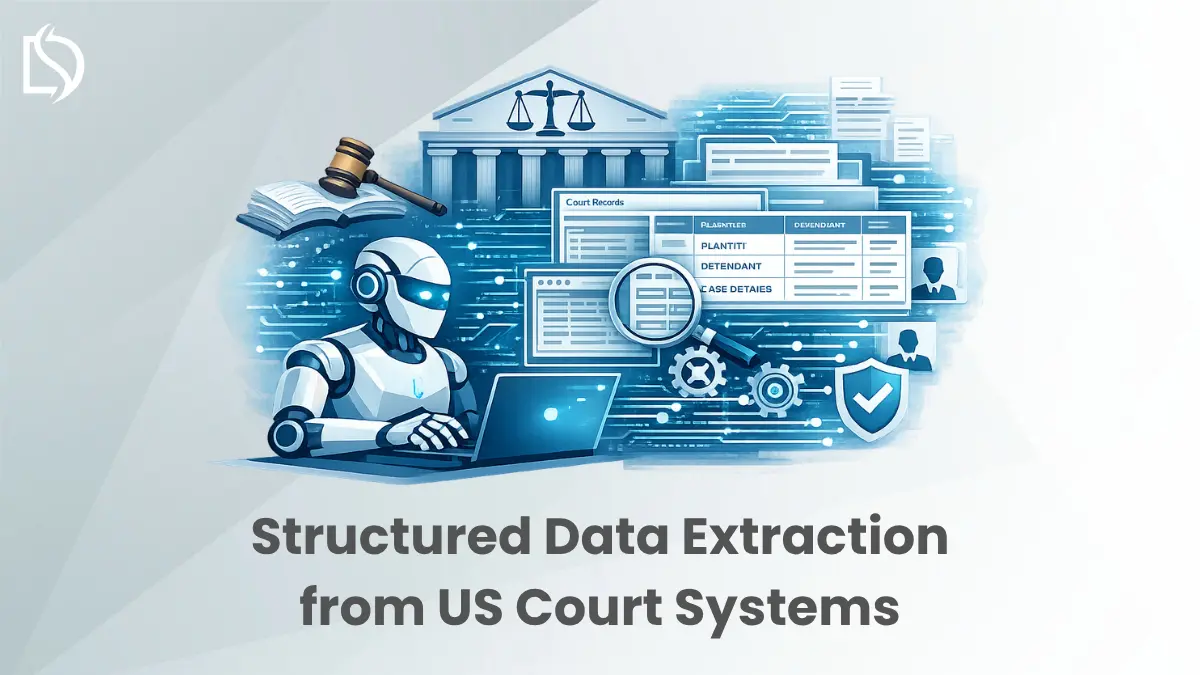
Structured Data Extraction from US Court Systems: An Agentic AI Approach to Legal Intelligence
By: The Data Engineering Team at DataSOS Technologies
For data architects building LegalTech platforms and enterprise risk dashboards, US court records provide essential intelligence. However, the United States judicial system presents a significant structural challenge for data integration.
With over 3,000 independent county and municipal courts, there is no standardized data model. A “Cause of Action” in Miami-Dade County might be stored under a completely different database format and column name than in Cook County, Illinois.
At DataSOS Technologies, we build data infrastructure for enterprise intelligence. Managing thousands of distinct ETL pipelines for these courts is highly inefficient. Court IT departments update their web layouts and database schemas frequently, often without documentation, which causes traditional rule-based extraction pipelines to break.
To build a stable data supply chain, we have transitioned away from traditional web scraping. Instead, we use Agentic AI to construct a unified integration layer over the fragmented court system. Here is a technical overview of how we extract, map, and resolve unstructured legal data at scale.
Challenges of Data Extraction from US Court Systems: Schema Fragmentation
Before deploying extraction infrastructure, technical teams need to address why standard integration methods struggle in the legal sector. The core issue is schema fragmentation.
In a standard environment, engineers consume data via well-documented REST or GraphQL APIs with predictable JSON payloads. In the public court system, the user interface itself acts as the API. This creates two distinct engineering hurdles:
- Limitations of Hardcoded Scripts: Historically, engineers built custom scripts (like Selenium or Puppeteer) for each county. If one county displayed the “Defendant Name” in an HTML <div> and another used a <table>, developers had to write and maintain two separate scripts.
- Managing UI Updates and Schema Drift: When a county IT department updates their software, the underlying HTML structure changes. Hardcoded scripts fail silently or pull incorrect data. Managing thousands of these brittle scripts requires constant manual intervention from engineering teams.
Using Agentic AI for Semantic Schema Mapping
We deploy Agentic AI to address front-end variations through semantic schema mapping. Rather than relying on explicit code instructions (such as specific XPaths), we deploy AI models trained to understand the context of the data on the screen. We provide the agent with a single, universal target schema, and it maps the court data accordingly.
- Semantic Interpretation: When the AI agent accesses a county docket, it uses Large Language Models (LLMs) to read the Document Object Model (DOM) semantically. It recognizes that varying terms like “Filing Date,” “Date of Action,” and “Action Dt” all map to the exact same field in our master schema.
- Self-Healing Infrastructure: If a court updates its web portal layout, a traditional script crashes. Our AI agent visually and semantically re-evaluates the page, locates where the target data has moved, and extracts it successfully. This adaptability minimizes the maintenance required for front-end schema drift.
Entity Resolution in Legal Data Management
Extracting the data is only the first step. One of the most complex engineering challenges in LegalTech is entity resolution—confirming that a legal entity in one dataset is the exact same entity in another.
Public court data contains frequent inconsistencies. A single corporation might be listed across different states under variations like:
- JPMorgan Chase Bank, N.A.
- J.P. Morgan Chase
- JP Morgan
If an intelligence platform treats these as three separate companies, downstream analytics will be inaccurate. To deliver clean, governance-ready data, our ETL pipeline executes rigorous entity resolution processes:
- String Normalization and Fuzzy Matching: We deploy string-matching algorithms to normalize company names, stripping out punctuation, legal suffixes (like LLC or Inc.), and formatting inconsistencies.
- Address Validation and Geocoding: Because company names alone are often insufficient to confirm identity, our pipeline extracts address strings from legal filings and cross-references them against official postal and geographic databases.
- Knowledge Graph Integration: By mapping the normalized entity name, validated address, and presiding jurisdiction, we create a distinct node in a knowledge graph. This ensures a single, deduplicated source of truth for downstream applications.
Delivery Architecture and System Integration
Once the unstructured court data is extracted, mapped, and deduplicated, it must be delivered to your internal systems efficiently. We engineer the delivery layer to align with your specific architectural requirements:
- Event-Driven Webhooks: For platforms requiring real-time updates (such as immediate alerts when a specific entity is sued), we push JSON payloads directly to your endpoints as soon as the data is processed.
- Direct Database Injection: We establish secure connections to cloud data warehouses (Snowflake, BigQuery, AWS Redshift) using automated ELT workflows.
- Batch Storage: For quantitative modeling and historical back-testing, we deliver structured, partitioned parquet files directly to secure storage environments like Amazon S3.
Engineering a Reliable Legal Data Infrastructure
Building LegalTech and enterprise intelligence platforms requires strict data integrity. Relying on an internal team of developers to constantly patch broken web scrapers is a misallocation of engineering resources.
By deploying Agentic AI for semantic mapping and entity resolution, DataSOS Technologies transforms fragmented US court records into a clean, predictable, and structured data feed.
Let us engineer your legal data infrastructure, so your team can focus on core product development.
SUBSCRIBE TO OUR NEWSLETTER
RECENT POSTS
 Data Scraping for AI Training: Legal and Ethical Considerations in 2026
- Building Self-Healing Data Extraction Pipelines With AI
- How AI Data Collection is Changing Legal Research in 2026
- How AI Agents Are Replacing Traditional Web Scraping Workflows
- From Raw Court Filings to Actionable Intelligence: A Technical Blueprint for AI-Driven Legal Data Aggregation