Architecting Proxy Chains for Distributed Traffic Flow in Akamai-Protected Environments
Table of Contents
Toggle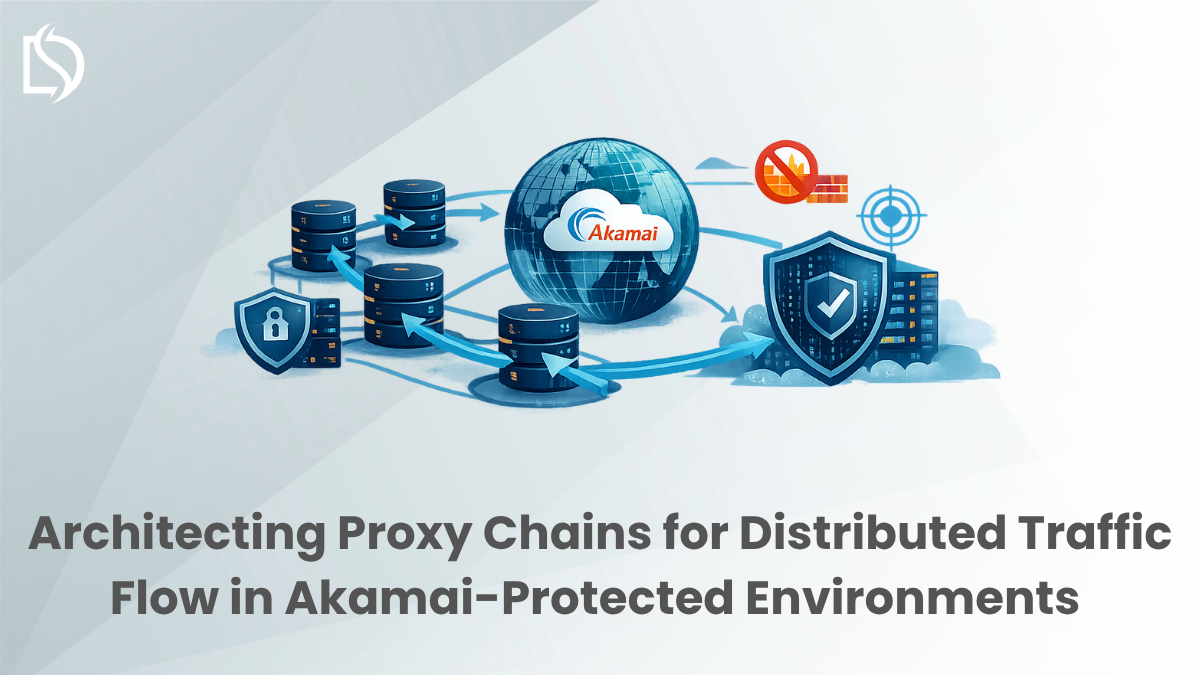
By: The Data Engineering Team at DataSOS Technologies
In the modern digital economy, unstructured web data is the raw material for enterprise growth. But sending an HTTP GET request is no longer enough to get that data at scale. The Internet has militarised – Akamai is at the front of that defence.
Secured by over half of the Fortune 500, including top financial institutions, global e-commerce giants and major airlines, Akamai’s Bot Manager is perhaps the most sophisticated Web Application Firewall (WAF) and anti-bot system on the market today. For CTOs and Lead Data Engineers, hitting an Akamai-protected endpoint will often throw HTTP 403 Forbidden errors, CAPTCHA loops, or worse: Silent ghosting, where the server returns fake data to poison your dataset.
At DataSOS Technologies, our infrastructure processes handle over 15 billion data points per month. Hard-earned experience has taught us that beating Akamai takes more than buying a bunch of proxies. It requires highly orchestrated distributed traffic flow and a deep understanding of how modern CDNs evaluate trust.
Here’s an engineer’s guide to managing proxy chains & distributed traffic flows on Akamai-protected environments.
Understanding the Adversary: How Akamai Evaluates Trust
Before you can route traffic through an Akamai edge server, you should understand that Akamai does not evaluate requests independently. It evaluates the entirety of the connection context.
Conventional WAFs expect SQL injection payloads or simple rate-limiting triggers. In contrast, Akamai’s Bot Manager uses a multiple-layer trust scoring model:
- IP Reputation & ASN Scoring: Akamai keeps a global ledger of IP behaviour. When an IP address from an AWS or DigitalOcean datacenter attempts to access a consumer retail site, its initial trust score drops immediately.
- TLS Fingerprinting (JA3/JA4): The TLS handshake occurs before the HTTP request is sent. Akamai checks the cypher suites, extensions and elliptic curves that your client offers. When your proxy forwards a request that looks like it came from a standard Python requests library or a Node.js axios client, the connection is flagged.
- HTTP/2 Pseudo-Header Order: Modern browsers send HTTP/2 pseudo-headers (:method, :authority, :scheme, :path) in a highly specific order depending on the browser engine (Chromium vs. Firefox). Akamai checks if your headers match the User-Agent you claim to be.
- Behavioural Telemetry: Once the page loads, Akamai’s client-side scripts track mouse movements, touch events and sensor data to distinguish a headless browser from a human user.
When one element of the chain breaks, your proxy IP is burnt.
The Failure of Legacy Proxy Rotation
Most middle-market web scraping operations use simple round robin proxy rotation. They buy 10,000 residential IPs and configure their scraper to switch to a new IP on every request. And against Akamai, that strategy is catastrophic.
Rotating IPs per request breaks session continuity. Imagine someone logging into an e-commerce site from New York, adding a product from Tokyo three seconds later and checking out from London two seconds later. Akamai’s behavioural engine will mark this as “impossible travel” or session hijacking.
Furthermore, the “noisy neighbour” problem still plagues shared proxy pools. And if another customer of your proxy provider is actively spamming an Akamai-protected target with the same exit node, that IP will have a negative reputation long before you send your first packet.
Architecting Intelligent Proxy Chains for Distributed Flow
To bypass sophisticated anti-bot defences and convert unstructured chaos into clean, enterprise-grade assets, you must move from proxy rotation to intelligent traffic shaping. Here is how elite data engineering teams manage proxy chains.
1. Cascading Proxy Architectures (The Waterfall Method)
Treating all proxies equally is a waste of capital. Residential proxies are expensive; datacenter proxies are cheap but easily blocked. A robust ETL data processing pipeline utilises a cascading proxy architecture:
- Tier 1: High-Quality Datacenter / ISP Proxies. These are used for the initial reconnaissance or for endpoints that have looser security rules. They offer high bandwidth and zero latency.
- Tier 2: Static Residential IPs. If Tier 1 fails (HTTP 403 or a CAPTCHA is served), the request cascades to a static residential IP. These IPs belong to real ISPs but are hosted in datacenters, offering a blend of high trust and high speed.
- Tier 3: Dynamic Rotating Residential / Mobile. For the most heavily fortified Akamai endpoints (like login portals or checkout flows), the traffic is routed through mobile carrier IPs (e.g., AT&T, Verizon). Mobile IPs are heavily NAT-ted (Network Address Translation), meaning thousands of legitimate users share a single IP. Akamai is highly reluctant to block mobile IPs, as doing so would block legitimate customers.
2. Session Persistence and “Sticky” IPs
Instead of rotating on every request, intelligent proxy chains utilise “sticky sessions.” When an IP successfully negotiates a TLS handshake and solves any initial JavaScript challenges, the proxy manager locks that IP to that specific session.
The scraper retains the session cookies, the Akamai _abck cookie, and the specific proxy IP. It then funnels a burst of traffic (e.g., 50 to 100 requests) through that established, trusted tunnel over the next few minutes. Once the session naturally degrades or the IP is rotated by the provider, the proxy manager gracefully retires the session and establishes a new one.
3. IP and Fingerprint Synchronisation
A proxy chain is useless if the IP address contradicts the browser fingerprint. A sophisticated traffic manager ensures absolute synchronicity:
- If the proxy manager selects an AT&T Mobile IP from Texas, it dynamically injects an Android or iOS mobile User-Agent.
- It ensures the time zone of the browser context matches the geo-location of the proxy IP.
- It matches the WebRTC leaks and language headers to the specific region.
Mismatching a mobile IP with a desktop Windows User-Agent is a massive red flag for Akamai’s heuristic engine.
4. Traffic Shaping and Jitter Injection
Distributed traffic flow means avoiding patterns. If your scraper hits an Akamai endpoint exactly every 2.0 seconds, statistical anomaly detection will ban you, regardless of how good your proxies are.
Advanced workflow automation requires injecting “jitter” into your proxy routing. Requests should follow a Poisson distribution, mimicking the bursty, unpredictable nature of real human traffic. Furthermore, traffic should be distributed across multiple target subdomains and endpoints simultaneously, rather than hammering a single API route.
The DataSOS Technologies Advantage
High volume data harvesting from Akamai-protected sources requires an orchestration of network protocols, proxy management & custom software development. Off-the-shelf scraping tools and basic proxy subscriptions will cause data latency, high error rates and broken pipelines.
At DataSOS Technologies, we do not guess; we engineer. We build custom software ecosystems that eliminate manual bottlenecks and create a faster path to informed decision-making.
Partnering with us for data extraction and ETL/ELT processing means you get a technology engine designed for billion-point workloads:
- Bespoke Proxy Orchestration: We manage the complex proxy chains, handling session persistence, TLS spoofing, and fallback cascading automatically.
- Zero Data Loss Infrastructure: No fault tolerance exists in our high-throughput pipelines. When an Akamai edge server blocks a node, our system reroutes and tries the request again with a new, more secure identity for faster delivery to your downstream applications.
- Certified Excellence: Operating with ISO 9001:2015 and ISO 27001:2013 certifications, we ensure that your data operations are not only effective but secure and compliant.
Stop letting defences of target websites drive your business intelligence. Data latency kills margins, and missing data makes bad strategic decisions. Schedule your free consultation with DataSOS Technologies today and discover how our intelligent automation and data engineering can transform your operations.