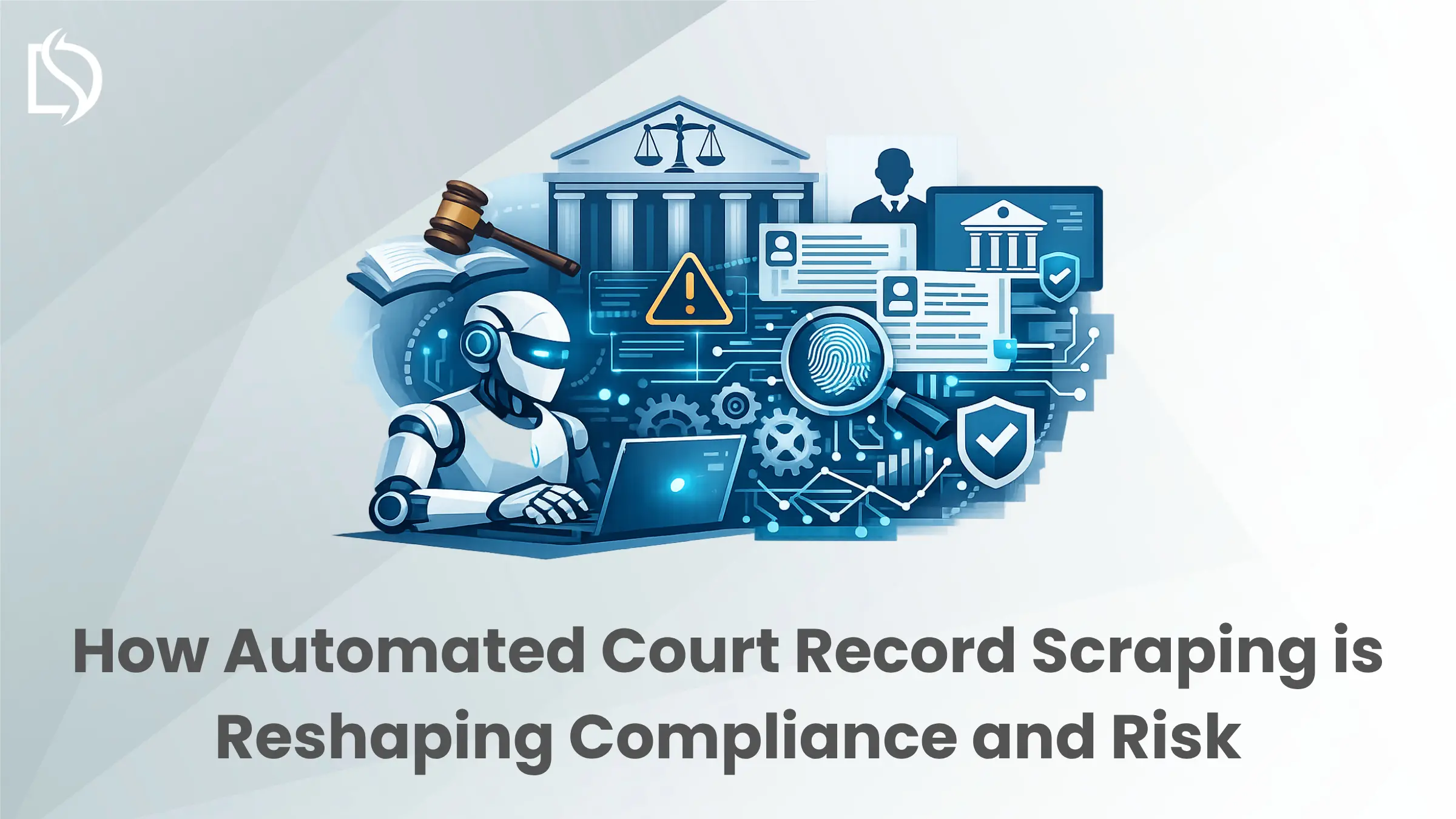
Agentic AI in Legal Data Intelligence: How Automated Court Record Scraping is Reshaping Compliance and Risk
By: The Data Engineering Team at DataSOS Technologies
In enterprise risk management and compliance, what you don’t know will hurt you. Whether you are underwriting a massive commercial real estate acquisition, onboarding a new global supplier, or executing continuous Know Your Business (KYB) checks, the foundational truth of corporate risk lies within the judicial system.
Lawsuits, bankruptcy filings, municipal liens, and regulatory judgments are the ultimate leading indicators of financial distress and corporate malfeasance.
However, for Chief Risk Officers and LegalTech innovators, accessing this intelligence presents a monumental data engineering hurdle. The United States does not have a single, unified database of civil and criminal court records. The data is locked behind the fragmented, actively hostile digital walls of over 3,000 disparate county and municipal court systems.
At DataSOS Technologies, we process over 15 billion data points monthly, building the custom data infrastructure that powers enterprise intelligence. We have watched the legacy methods of legal data gathering collapse under the weight of modern web security.
A new architectural standard has emerged today with Agentic AI. Here’s how autonomous, AI-driven data extraction is rewriting compliance, risk management and legal data intelligence rules.
Why Traditional Legal Scraping No Longer Works
Historically, aggregating court data was a manual, brute-force operation. Companies relied on vast armies of “human middleware” clerks manually logging into county websites, searching dockets, and copying text into spreadsheets. When automation was attempted, it was through deterministic, rule-based web scraping (like basic Python and Selenium scripts).
Rule-based scraping against municipal court systems is functionally obsolete due to three primary bottlenecks:
- Aggressive Anti-Bot Protections: To protect their servers, county courts utilize aggressive Web Application Firewalls (WAFs) like Cloudflare, Akamai, and Datadome. A traditional script navigating a docket search is instantly flagged by TLS fingerprinting or IP reputation models and blocked.
- Inconsistent and Unstable Court Interfaces: The court web portals have become notoriously outdated by relying on asynchronous JavaScript rendering (AJAX), nested iframes and unpredictable DOM structures. A script hardcoded to click a specific “Search” button crashes the moment the county IT department updates the CSS layout.
- Critical Data Locked in Documents: Court data rarely exists in clean HTML tables. The actual intelligence of who is suing whom, for how much, and why, is hidden in scanned PDFs or TIFF images of physical legal complaints, completely invisible to traditional HTML scrapers.
When your internal data team spends countless hours a week patching broken scripts and rotating proxies to keep a small flow of legal data coming in, your risk models are running on unreliable information.
A New Approach: Agentic AI in Data Extraction
To harvest high-volume data from the web’s most difficult sources, you must transition from deterministic scripts to probabilistic, autonomous agents.
Agentic AI refers to software systems that are given a high-level goal (e.g., “Extract all new commercial litigation filings from the Delaware Court of Chancery today”) and possess the cognitive capability to dynamically navigate the environment to achieve that goal. Here is how Agentic AI transforms the legal data pipeline:
1. Adaptive Navigation and Self-Healing Systems
An AI agent does not look for a specific line of code; it “sees” the webpage semantically, much like a human investigator. Using advanced Computer Vision (CV) and Large Language Models (LLMs), the agent understands the visual layout of a court portal.
If a county updates its website and moves the “Case Search” portal behind a new login flow, a legacy script crashes. An AI agent, however, dynamically adapts. It recognizes the new form fields, understands the context, and successfully inputs the search parameters, creating a self-healing pipeline that guarantees 99.9% data uptime.
2. Bypassing Modern Anti-Bot Defenses
Bypassing modern anti-bot defenses requires more than just masking an IP address. Agentic AI employs Cognitive Evasion.
By training models on human browser telemetry, these agents generate synthetic human behavior natively. They introduce realistic mouse entropy, pause to “read” content, and execute perfect TLS handshakes. When combined with DataSOS’s proprietary fingerprint rotation and global proxy networks, the agents slip through enterprise-grade security barriers undetected, ensuring your data supply chain is never blocked.
3. NLP and Contextual Document Extraction
Access is useless without precision. When an AI agent reaches a court docket, it frequently encounters an unstructured, 50-page scanned PDF.
This is where the agent’s cognitive “brain” takes over.
- First, it uses state-of-the-art Optical Character Recognition (OCR) to convert the scanned images into machine-readable text.
- Next, it applies Natural Language Processing (NLP) to perform contextual extraction. It does not just read the text; it understands the legal syntax. It accurately isolates the Plaintiff, the Defendant, the Cause of Action, and the Financial Damages Sought, ignoring the surrounding legal boilerplate.
How AI Scraping is Reshaping Compliance and Risk
By eliminating data latency and structuring the unstructured, Agentic AI enables entirely new operational capabilities for enterprises.
Continuous KYB and Third-Party Risk Monitoring
Historically, Know Your Business (KYB) checks were “point-in-time.” You vetted a supplier when you onboarded them, but what happens if they are sued for massive fraud two years later?
Agentic AI enables Continuous Monitoring. By autonomously scraping thousands of jurisdictions daily, risk management platforms can instantly alert a Chief Risk Officer the moment a critical supplier or partner is hit with a regulatory fine, a breach of contract lawsuit, or a bankruptcy filing. You move from reactive damage control to proactive risk mitigation.
Real Estate Underwriting and Title Intelligence
In commercial real estate, hidden liabilities destroy margins. Before finalizing a multi-million-dollar acquisition, underwriting teams need absolute certainty regarding a property’s legal standing.
AI-driven data pipelines can instantaneously harvest historical zoning disputes, municipal code violations, mechanic’s liens, and environmental lawsuits tied to a specific parcel or developer across multiple county databases. This accelerates the due diligence process from weeks to hours, allowing funds to deploy capital with algorithmic precision.
Algorithmic Trading and Alternative Data
For quantitative hedge funds, pending litigation against a publicly traded company is the ultimate alternative data signal. A massive class-action lawsuit filed in a remote district court can crash a stock price—but only if the algorithm knows about it before the wider market. Agentic AI pipelines ingest, structure, and deliver these civil filings in real-time, providing the zero-latency intelligence required to execute high-frequency trades.
The Critical Role of ETL and Security
Scraping the data is only half the battle. In the compliance sector, data must be perfectly clean and fundamentally secure. At DataSOS Technologies, we engineer the full ETL/ELT Data Processing pipeline.
- Automated Cleaning & Deduplication: Legal entities are notoriously messy (e.g., “Acme Corp” vs. “Acme Corporation Inc.”). Our pipelines standardize entity names, validate addresses against municipal registries, and merge fragmented records to ensure a single source of truth.
- Custom API Integration: We deliver this structured intelligence exactly how your risk platforms need it—via JSON feeds, direct SQL database injection, or custom-built APIs, ready to power your internal dashboards.
- Certified Enterprise Security: Legal data involves highly sensitive information. DataSOS operates with a compliance-first approach, ensuring that data is encrypted in transit and at rest, and that our extraction methods strictly align with ethical scraping standards.
Engineering Your Strategic Advantage
In modern enterprise risk management, the organization with the fastest, cleanest data wins.
Relying on fragile scripts or human manual entry to navigate the complexities of US court records is a guaranteed path to critical blind spots. By deploying Agentic AI, you transform the unstructured chaos of 3,000+ court systems into a centralized, real-time command center for compliance and risk.
At DataSOS Technologies, we build the custom software infrastructure that automates the impossible. Let us handle the complex engineering of data acquisition, so your team can focus entirely on strategic risk mitigation.
Stop guessing about your legal exposure. Start commanding the source. Schedule your free consultation with DataSOS Technologies today and engineer the next phase of your risk intelligence.
SUBSCRIBE TO OUR NEWSLETTER
RECENT POSTS
 Data Scraping for AI Training: Legal and Ethical Considerations in 2026
- Building Self-Healing Data Extraction Pipelines With AI
- How AI Data Collection is Changing Legal Research in 2026
- How AI Agents Are Replacing Traditional Web Scraping Workflows
- From Raw Court Filings to Actionable Intelligence: A Technical Blueprint for AI-Driven Legal Data Aggregation