The Impact of AI in Bulk Data Scraping and the Rise of Autonomous Agents
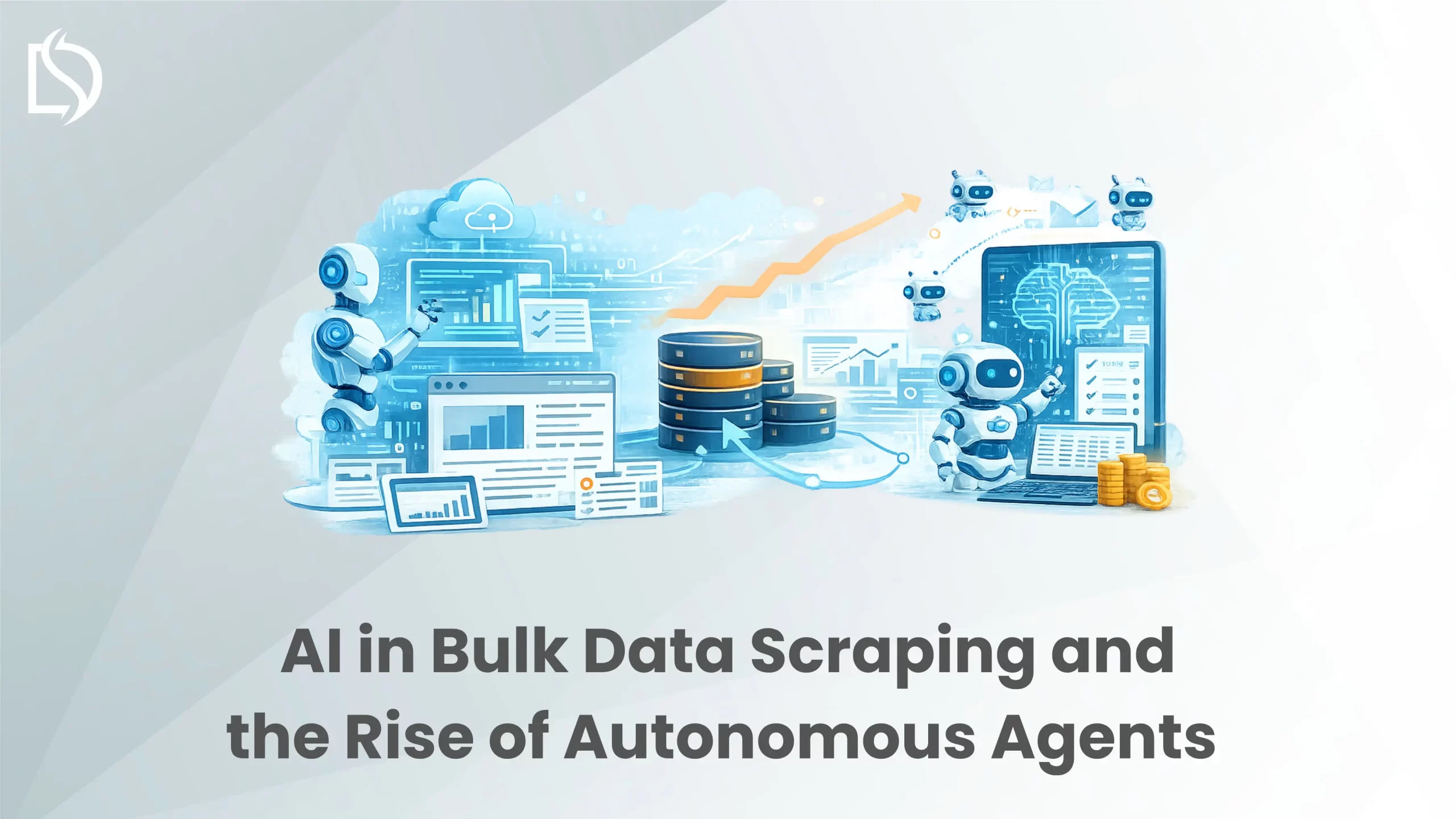
By: The Data Engineering Team at DataSOS Technologies
The modern internet is fundamentally hostile to automated data collection. Bots now drive more than 40% of internet traffic. In response, target websites have erected extremely complex Web Application Firewalls (WAFs), dynamic JavaScript rendering and aggressive behavioural tracking systems.
If your data infrastructure runs on traditional, rule-based web scraping scripts, you are losing. Static scripts crash the moment a target site updates its CSS layout. Cloudflare, Datadome, or Incapsula instantly ghost simple HTTP requests. When your internal engineering team is wasting 20+ hours a week fixing broken scripts and managing IP bans, your data supply chain is broken.
We are currently witnessing the most significant architectural shift in data engineering of this decade: the transition from static web scraping to AI-driven Autonomous Agents.
At DataSOS Technologies, we engineer resilient, self-healing acquisition pipelines that process over 15 billion data points monthly. Here is an engineering deep-dive into how Artificial Intelligence and cognitive agents are fundamentally rewriting the rules of bulk data extraction and Intelligent Automation.
The Evolution: From Rule-Based Scripts to Cognitive Agents
The transition must be explained to understand the impact of AI in this space. Web scraping was deterministic. It was like copying from a fixed template. You knew where the price or title would appear, so you could get it reliably. But the system breaks when the layout changes.
- Fragility: The scraper fails if the site developer changes the class name to price-tag-v2, causing missing data and broken downstream dashboards.
- Predictability: Deterministic scripts behave as machines. They click at exact intervals, lack mouse jitter, and execute TLS handshakes that lack human browser fingerprints, triggering immediate bans from anti-bot systems.
AI Agents change this paradigm from deterministic to probabilistic and adaptive. Instead of being told exactly how to find the data, an AI agent is told, for example, to find the lowest competitor price for SKU 12345 on this marketplace and then navigates the environment to do so dynamically.
How AI Agents are Transforming Bulk Scraping
1. Semantic Parsing and Self-Healing Pipelines
The maintenance nightmare of broken scrapers is solved by semantic HTML parsing. Artificial agents, instead of hardcoding XPaths or CSS selectors, use Computer Vision (CV) and Large Language Models (LLMs) to understand the visual and semantic layout of a webpage like a human would.
If an e-commerce site completely redesigns its product page, an AI agent doesn’t crash. It scans the Document Object Model (DOM), identifies the cluster of elements that semantically represent a “price,” and extracts it regardless of the underlying code changes. At DataSOS, we integrate these cognitive capabilities to create Self-Healing Scripts. Our monitoring systems detect target site changes and often deploy fixes autonomously before your team experiences any disruption.
2. Cognitive Evasion of Advanced Anti-Bots
Where others stop at systems like Akamai, Datadome, and Incapsula, we begin. Modern WAFs do not just check your IP address; they analyse your behaviour.
AI agents excel at Cognitive Evasion. By training machine learning models on human browser telemetry, agents can dynamically generate synthetic but mathematically perfect human behaviour. They introduce realistic mouse entropy, human-like typing cadences, and probabilistic pacing. When combined with advanced headless browser automation and proprietary fingerprint rotation, AI agents slip through enterprise-grade security barriers undetected, ensuring 99.9% data uptime.
3. Intelligent Data Extraction from Unstructured Chaos
Access is useless without precision. Not all valuable data is neatly formatted in HTML tables. Much of it is buried in unstructured text, nested AJAX calls, or complex media.
AI agents utilise Natural Language Processing (NLP) to perform contextual extraction. Whether it is pulling sentiment data from chaotic social media forums, isolating specific clauses from regulatory PDFs, or using Optical Character Recognition (OCR) to extract data from scanned financial filings, AI turns unstructured chaos into clean, governance-ready assets.
The Intersection of Scraping and RPA: The “Brain” and the “Hands”
Extracting data is only half the battle. What happens once the data is acquired? This is where AI-driven scraping merges with Robotic Process Automation (RPA).
Many enterprise leaders confuse AI and RPA, but they play different yet highly synergistic roles.
- RPA is the “Hands”: Standard RPA is rule-based. It follows strict instructions to move data, fill out forms, and execute transactions.
- AI is the “Brains”: AI is cognitive. It can read, interpret, decide, and adapt.
When you combine AI scraping agents with custom RPA development, you create Intelligent Automation.
Consider the problem of “Human Middleware.” In many legacy enterprises, skilled employees are forced to act as bridges between disconnected systems. They download a competitor’s pricing report (manual scraping), interpret the data, and then manually update their own company’s pricing in an AS400 legacy mainframe that lacks an API. This creates a volume cap, a high accuracy gap (typos), and massive talent drain. An AI agent eliminates this.
- The AI Scraping Agent continuously monitors the competitor’s site, bypassing anti-bots to extract live pricing.
- It uses NLP to standardise the currency and product matching.
- The Unattended RPA Bot securely logs into your legacy mainframe via the User Interface (UI) and updates your pricing in real-time.
No human intervention. Zero data latency. 100% execution accuracy.
The Strategic ROI of Autonomous Data Agents
Moving from basic web scraping to an AI-agent-driven data infrastructure is not just an IT upgrade; it is a fundamental competitive advantage.
- Real-Time Market Dominance: In sectors like travel, hospitality, or algorithmic trading, data latency kills margins. AI agents process thousands of endpoints simultaneously, ensuring your predictive models are fed with live, not lagging, intelligence.
- Elimination of Maintenance Overhead: By transitioning to self-healing pipelines, your internal data engineers can stop playing “whack-a-mole” with broken XPaths and focus on building strategic data models.
- Non-Invasive Legacy Integration: Because Intelligent Automation operates at the UI level, you can automate complex workflows and inject scraped data into older systems without requiring multi-year, multi-million-dollar API development overhauls.
Stop Struggling for Access. Start Commanding the Source.
Building a 24/7 Digital Workforce capable of bypassing the internet’s toughest firewalls requires more than off-the-shelf software. It requires a dedicated data infrastructure partner with a deep software engineering mindset.
At DataSOS Technologies, we do not rely on fragile “record-and-playback” tools. Our developers utilise advanced programming (Python, C#, .NET) and industry-leading automation platforms (UiPath, Automation Anywhere) to engineer custom, AI-augmented scraping and RPA solutions.
We handle the dirty work of acquisition, cleaning, and delivery, so you can focus entirely on the intelligence.
Ready to turn raw web data into revenue? Stop letting technical barriers slow your growth. Schedule a Developer Consultation with DataSOS Technologies today and build an intelligent data supply chain that actually scales.
SUBSCRIBE TO OUR NEWSLETTER
RECENT POSTS
 How to Create LLM-Ready Datasets from Public Web Data
- Data Scraping for AI Training: Legal and Ethical Considerations in 2026
- Building Self-Healing Data Extraction Pipelines With AI
- How AI Data Collection is Changing Legal Research in 2026
- How AI Agents Are Replacing Traditional Web Scraping Workflows